

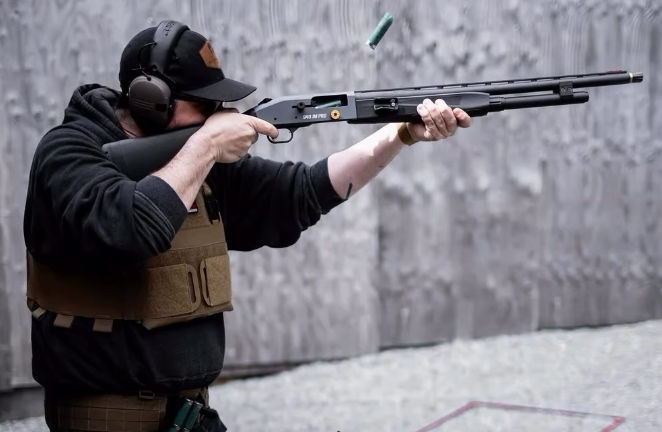
The eyes never lie
In practical shooting, what you see drives everything you do. Grip, trigger control, movement—it all starts with visual processing. The faster and more efficiently your eyes pick up information, the faster your body can execute. That’s where ocular occlusion training comes in.
This is one of the most underutilized, high-impact training methods available to competitive shooters.
Our team at Range Junkie is going to break it down.
What is Ocular Occlusion Training?

Ocular occlusion training involves partially blocking vision in one eye to force your brain to work harder to process visual information.
Typically, shooters will:
- Cover or blur the non-dominant eye
- Use frosted tape, occlusion patches, or specialized eyewear
- Train while maintaining both eyes open
The goal isn’t to shoot with one eye—it’s to train your visual system to prioritize clarity, focus, and target acquisition under constraint.
Why It Works
Your brain is constantly filtering visual input. When you occlude one eye, you:
- Reduce visual “noise”
- Force dominant-eye clarity
- Improve target-to-sight alignment speed
- Strengthen neural pathways tied to visual processing
In short, you're creating artificial difficulty in training—so match conditions feel easier.
Application in Practical Shooting (IPSC / IDPA)
In dynamic shooting sports like IPSC and IDPA, visual efficiency is everything.
You’re constantly:
- Transitioning between targets
- Picking up sights or dot instantly
- Managing depth and movement
- Processing stage plans in real time
Ocular occlusion helps train:
- Faster target acquisition
- Cleaner transitions
- Improved dot tracking
- Better visual patience on difficult shots
How to Train with Ocular Occlusion

1. Start in Dry Fire
Your foundation should always be controlled.
Using your Range Junkie Dry Fire System, apply occlusion and run:
- Target transitions
- Draw to first shot
- Reloads with visual focus shifts
Focus on:
- Seeing the sights clearly
- Calling your shots visually
- Eliminating hesitation
2. Tape Method (Simple & Effective)
Apply a small piece of translucent tape to your shooting glasses:
- Place it over the non-dominant eye
- Position it so it blocks the sight picture, not peripheral vision
This allows:
- Peripheral awareness to remain intact
- Central vision to be driven by the dominant eye
3. Progressive Difficulty
Don’t stay static—build it like any other skill:
Phase 1:
- Static targets
- Close distance
- Clean sight picture focus
Phase 2:
- Multiple targets
- Controlled transitions
Phase 3:
- Movement + transitions
- Partial targets / no-shoots
4. Live Fire Integration
Once comfortable, bring it to the range:
- Start with simple drills (Bill Drills, transitions)
- Avoid jumping straight into full stages
- Focus on visual confirmation, not speed
Then remove the occlusion.
You’ll immediately notice:
- Faster visual pickup
- Cleaner sight alignment
- Reduced “search time” for the dot
Common Mistakes
Mistakes happen. Take a look at some commonly made mistakes.
-
Closing one eye completely
→ This defeats the purpose. Keep both eyes open. -
Overusing occlusion
→ This is a training tool, not a permanent method. -
Going too fast too early
→ This is about visual refinement, not raw speed.
Where This Fits in Your Training

Ocular occlusion is not a replacement—it’s an amplifier.
Pair it with:
- Dry fire reps
- Movement drills
- Match simulation
- Visual patience training
Used correctly, it builds discipline in what you see, not just what you do.
The Range Junkie Mindset
At Range Junkie, we train with purpose.
We don’t just burn reps—we build performance.
Ocular occlusion is a perfect example of training smarter:
- Create challenge in practice
- Build confidence in performance
- Execute when it counts
Final Thought
You don’t miss because your hands are slow. You miss because your eyes weren’t ready.
Train your vision.
Sharpen your focus.
And when it’s time to step up to the line—
Train to Compete. Compete to Win.
Be sure to follow Range Junkie on Instagram.
Share:
Stop Chasing Matches. Start Building Skill.
One Bad Stage Doesn't Define Your Match